
You start your morning run feeling a familiar ache behind your heel. The first few minutes are uncomfortable, but as you settle into your pace, the pain seems to ease. By the time you finish, you’re feeling reasonably good. Then, later that evening or the following morning, the stiffness returns.
Achilles tendon pain can behave this way for weeks or even months. Some runners find they can push through a workout but struggle with the first steps out of bed the next day. Others begin noticing discomfort when climbing stairs, walking uphill, or standing on their toes.
When rest, footwear changes, and exercises haven’t provided lasting improvement, you may begin looking into treatments such as extracorporeal shockwave therapy (ESWT). At Associated Podiatrists, P.C., in Novi, Michigan, we evaluate Achilles tendon conditions and offer shockwave therapy as a nonsurgical treatment option. Understanding when it may help, what the research shows, and why rehabilitation remains important can help you decide whether it’s worth discussing with your podiatrist.
Why Achilles Tendon Pain Often Gets Worse With Activity
Your Achilles tendon connects the calf muscles to the heel bone and plays an important role in walking, running, jumping, and pushing off the ground. It handles considerable force, particularly during activities that involve repeated acceleration, climbing, or sudden changes in direction.
Problems often develop when the tendon is asked to handle more than it has recently been conditioned to tolerate. A runner increases mileage too quickly. Someone returns to tennis after several months away. An active adult begins a new fitness routine that involves repeated jumping or hill workouts.
These changes don’t always cause immediate injury. Symptoms may develop gradually, beginning as mild stiffness before progressing to discomfort that interferes with exercise.
Why Does Achilles Pain Sometimes Improve After Warming Up?
One frustrating feature of Achilles tendinopathy is that discomfort may ease after several minutes of movement. You might feel stiff when you first get out of bed, loosen up during a walk, and assume the problem is improving.
Unfortunately, temporary relief during activity doesn’t necessarily mean the tendon is tolerating the workload well. Pain may return later, particularly after running, jumping, or spending long periods on your feet.
Morning stiffness, tenderness, and recurring discomfort after exercise are common features of Achilles tendinopathy. The condition can affect the middle portion of the tendon or the area where it attaches to the heel bone. That distinction matters because the two locations may respond differently to certain exercises and treatments.
When Achilles Pain Needs Prompt Attention
A gradual ache is different from a sudden injury. If you feel a pop near your heel, develop severe pain or swelling, or suddenly have difficulty pushing off your foot, seek prompt medical evaluation.
An Achilles tendon rupture can sometimes be mistaken for a strain. Continuing to exercise without an appropriate assessment may delay necessary treatment.
Also Read: Shockwave Therapy vs. Physical Therapy for Achilles Tendonitis
What Is Shockwave Therapy for Achilles Tendon Pain?
Extracorporeal shockwave therapy uses acoustic energy delivered through the skin to a targeted area. Depending on the equipment, treatment may involve focused shockwaves or radial pressure waves. These technologies differ in how they deliver energy, and research findings for one approach shouldn’t automatically be applied to the other.
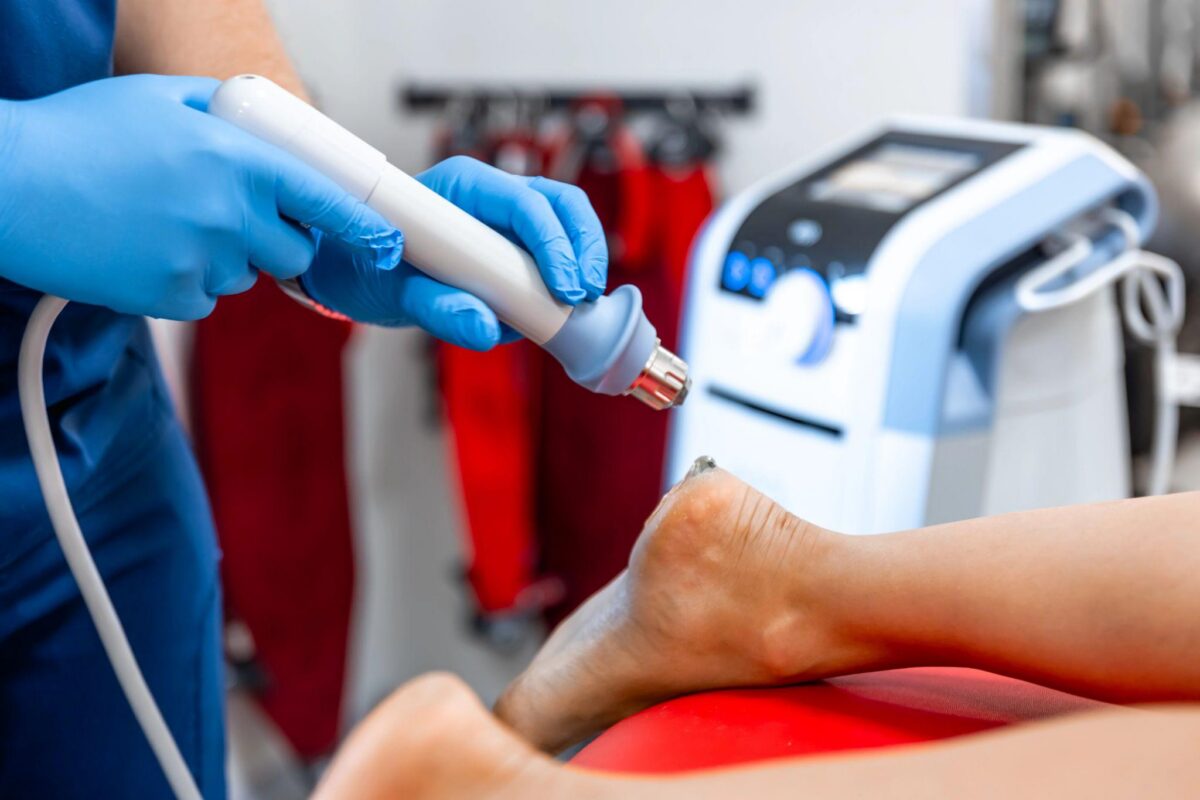
During treatment, a clinician places an applicator against the skin over the affected region. Pulses of acoustic energy are delivered according to the selected device and protocol.
Researchers have investigated whether shockwave treatment influences local tissue responses and improves pain or function in persistent tendon conditions. The proposed biological effects are still being studied, and they shouldn’t be confused with proof that treatment repairs damaged tendon tissue.
For Achilles tendinopathy, the clinical evidence remains uncertain. Some studies have reported improvements, particularly when shockwave therapy is combined with exercise-based rehabilitation. Others have found little or no additional benefit. Current research does not establish a consistent, clinically meaningful advantage for routine use in every patient with Achilles tendinopathy.
That uncertainty deserves an open discussion before treatment. Shockwave therapy may be an option in selected circumstances, but it isn’t a guaranteed solution or a replacement for progressive strengthening.
When Might Shockwave Therapy Be Considered?
Imagine you’ve reduced your running mileage, adjusted your training schedule, and completed a structured exercise program, yet the same tendon pain continues to interrupt your activities. You can still walk and exercise to some extent, but attempts to increase your workload bring the symptoms back.
This is the type of situation in which a podiatrist may discuss additional treatment options, including shockwave therapy.
Before recommending it, we need to establish where the pain originates and what you’ve already tried. Pain at the back of the heel isn’t always caused by Achilles tendinopathy. Other conditions can produce similar symptoms, and a suspected tear or rupture requires a different approach.
The location of the tendon problem also influences treatment. Midportion Achilles tendinopathy affects the tendon above its attachment to the heel, while insertional tendinopathy occurs where the tendon attaches to the heel bone. Certain loading exercises and treatment protocols may need to be modified for insertional symptoms.
What If You Haven’t Tried Rehabilitation Yet?
A progressive tendon-loading program is generally a central part of care for Achilles tendinopathy, particularly when the problem affects the middle portion of the tendon.
These programs gradually challenge the calf muscles and Achilles tendon to improve strength and tolerance for activity. Your podiatrist may also discuss footwear, temporary activity changes, or physical therapy.
Shockwave treatment shouldn’t replace this work. Even when discomfort improves, the tendon still needs sufficient strength and capacity to handle running, jumping, and other demanding movements.
Also Read: Can Shockwave Therapy Help Chronic Heel Pain That Won’t Go Away?
What Happens During a Shockwave Therapy Appointment?
Your first step is an evaluation of the painful area. We’ll discuss when your symptoms began, which activities make them worse, and whether you’ve noticed morning stiffness or swelling. Previous injuries, medications, and treatments are also relevant.
The examination may include checking tendon tenderness, ankle movement, calf strength, and your ability to tolerate certain movements. Imaging may be appropriate when the diagnosis is unclear or another injury is suspected.
If shockwave therapy is suitable, the treatment area is identified and the device settings are selected. A coupling gel is typically applied before the applicator is placed against the skin.
You may feel tapping, pressure, or temporary discomfort as the acoustic pulses are delivered. The sensation varies according to the equipment, treatment settings, and sensitivity of the affected area.
Treatment schedules aren’t identical for every patient. Some protocols involve several sessions over multiple weeks. The number of visits, expected costs, possible benefits, and criteria for evaluating progress should be discussed before treatment begins.
Are There Side Effects?
Temporary soreness, redness, or bruising can occur after shockwave therapy. Your podiatrist should also review precautions related to your medical history and the specific device being used.
A suspected tendon rupture, infection near the treatment area, certain bleeding conditions, anticoagulant medications, and pregnancy-related considerations may affect whether treatment is appropriate.
Be sure to disclose your medications and relevant medical conditions before starting treatment.
Can You Keep Running or Exercising During Treatment?
For many active adults, this is the most important question. Taking several weeks away from a favorite activity can be frustrating, particularly when you’ve already tried resting without lasting improvement.
Complete inactivity isn’t always necessary for Achilles tendinopathy. However, continuing your usual training volume while the tendon remains painful may prolong symptoms.
The decision should reflect your current pain, strength, activity demands, and response to loading. You may need to temporarily reduce running mileage, avoid hill workouts, or limit jumping while maintaining other forms of movement that your tendon tolerates.
A return-to-running plan should progress gradually. Feeling better after one treatment doesn’t mean the tendon is immediately ready for sprinting, distance running, or competitive sports.
Why Rehabilitation Still Matters After Shockwave Therapy
Pain relief and tendon capacity aren’t the same thing. You may notice less discomfort during walking while still lacking the strength needed for more demanding exercise.
Progressive calf strengthening helps address that gap. Exercises may begin at a manageable level and become more challenging as symptoms and function improve.
For insertional Achilles tendinopathy, certain exercises involving deep ankle dorsiflexion may need modification because they can increase compression near the tendon attachment.
Recovery may take several months, especially when symptoms have been present for a long time. Progress is rarely perfectly linear, and occasional soreness doesn’t automatically mean treatment has failed. Persistent worsening, however, warrants reassessment.
When Achilles Tendon Pain Keeps Coming Back
Recurring pain often signals that the tendon hasn’t regained enough tolerance for the activities you’re asking it to perform.
Consider someone who stops running for two weeks, feels better, and immediately returns to their previous mileage. The pain may disappear during the break, only to return when training resumes because the underlying loading problem hasn’t been addressed.
A similar pattern can develop after repeated cycles of stretching, rest, and over-the-counter pain relief without a structured strengthening plan.
An evaluation can help identify factors contributing to the problem, including training changes, calf weakness, footwear concerns, and the location of tendon symptoms.
At Associated Podiatrists, P.C., we can assess persistent Achilles pain and discuss the available treatment options. When shockwave therapy is considered, it should fit into a plan that also addresses rehabilitation and a safe return to activity.
Also Read: Shockwave Therapy vs. Cortisone Injections for Chronic Heel Pain
Frequently Asked Questions About Shockwave Therapy for Achilles Tendon Pain
1. Does Shockwave Therapy Heal a Damaged Achilles Tendon?
There isn’t sufficient clinical evidence to promise that shockwave therapy repairs damaged Achilles tendon tissue. Researchers continue to investigate its biological effects, but proposed healing mechanisms don’t establish that structural tendon repair occurs in every patient.
2. Is Shockwave Therapy Painful?
You may feel tapping, pressure, or discomfort during treatment. Sensitivity varies depending on the treatment area, equipment, and settings. Temporary soreness afterward is also possible.
3. How Many Shockwave Therapy Sessions Will I Need?
Some treatment plans involve several appointments over multiple weeks, but there’s no universal schedule for Achilles tendinopathy. The proposed treatment plan should reflect your diagnosis, the device being used, and how progress will be evaluated.
4. Can I Exercise After Shockwave Therapy?
Activity recommendations depend on your condition and the treatment protocol. You may need to modify running, jumping, or other demanding activities while continuing appropriate rehabilitation exercises. Follow the instructions provided by your treating clinician.
5. Where Can I Get Shockwave Therapy for Achilles Tendon Pain in Novi?
Associated Podiatrists, P.C.,in Novi, Michigan, offers extracorporeal shockwave therapy as part of its foot and ankle treatment services. Schedule an evaluation to discuss your Achilles tendon symptoms and whether this treatment may be appropriate.
Get Back to the Activities You Enjoy With Associated Podiatrists, P.C.
Achilles tendon pain has a way of changing your routine. You start avoiding hills, cutting workouts short, or wondering whether the next run will leave you limping the following morning. When symptoms continue despite your efforts to manage them, it’s worth finding out why.
At Associated Podiatrists, P.C.,in Novi, we evaluate Achilles tendon pain and offer nonsurgical treatment options, including extracorporeal shockwave therapy when appropriate. We’ll discuss your symptoms, examine the affected tendon, and help you understand the role of rehabilitation and other treatment options.
Treatment schedules aren’t identical for every patient. Some protocols involve several sessions over multiple weeks. The number of visits, expected costs, possible benefits, and criteria for evaluating progress should be discussed before treatment begins.
Are There Side Effects?
Temporary soreness, redness, or bruising can occur after shockwave therapy. Your podiatrist should also review precautions related to your medical history and the specific device being used.
A suspected tendon rupture, infection near the treatment area, certain bleeding conditions, anticoagulant medications, and pregnancy-related considerations may affect whether treatment is appropriate.
Be sure to disclose your medications and relevant medical conditions before starting treatment.