
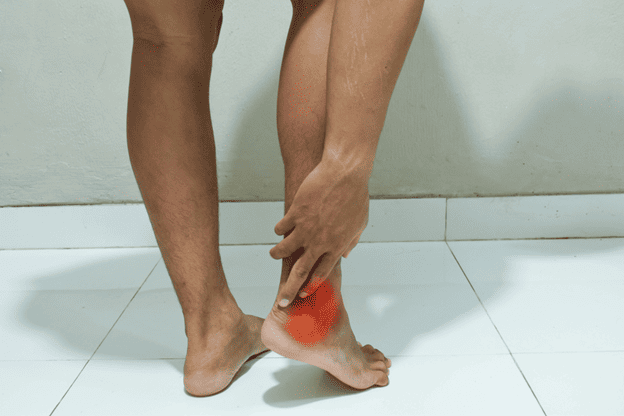
Associated Podiatrists, P.C. evaluates both Extracorporeal Shockwave Therapy (ESWT) and specialized physical therapy when treating Achilles tendinopathy, with treatment selected according to the location and severity of tendon involvement, symptoms, and activity goals. Physical therapy uses progressive loading exercises to improve calf strength and the tendon’s ability to tolerate stress, while ESWT delivers acoustic waves to the affected area and is used to stimulate biological processes associated with tendon healing and pain modulation.
For chronic or difficult-to-treat cases, the podiatrists at Associated Podiatrists, P.C. may recommend combining both approaches as part of an individualized treatment plan.
Understanding Achilles Tendon Pathology: Insertional vs. Non-Insertional
Achilles tendonitis, more accurately described in many cases as Achilles tendinopathy, can affect different portions of the tendon. Understanding where the tendon is damaged helps determine which treatment strategies may be appropriate.
Non-Insertional Achilles Tendinopathy (Mid-Substance)
Non-insertional Achilles tendinopathy occurs in the middle portion of the Achilles tendon, typically about 2 to 6 cm above its attachment to the heel bone. This region has relatively limited blood supply and may develop tendon thickening, degeneration, and microscopic tears.
For active patients and runners, repetitive loading can prevent the tendon from adequately recovering. Treatment therefore focuses on improving the tendon’s ability to tolerate mechanical loads while addressing contributing biomechanical factors.
Insertional Achilles Tendinopathy & Heel Spurs
Insertional Achilles tendinopathy affects the point where the Achilles tendon attaches to the calcaneus, or heel bone. This form can be accompanied by irritation of the retrocalcaneal bursa or calcified deposits and bone spurs around the tendon attachment.
Because insertional and non-insertional disease affect different anatomical areas, the appropriate exercise program and treatment strategy may differ. A podiatric evaluation can help identify the location and severity of tendon degeneration.
Also Read: Here are 10 signs you should see a Podiatrist:
Comparative Decision Framework: Shockwave Therapy vs. Physical Therapy
When comparing shockwave therapy with physical therapy for Achilles tendonitis, the two approaches work through different mechanisms. Physical therapy emphasizes progressive mechanical loading and functional rehabilitation, while ESWT is intended to provide a biological stimulus to chronically affected tendon tissue.
| Clinical Parameter | Shockwave Therapy (ESWT) | Physical Therapy |
|---|---|---|
| Primary Treatment Mechanism | Acoustic waves provide a mechanical stimulus intended to influence tendon healing and pain-related processes | Progressive tendon loading promotes adaptation, strength, and improved load tolerance |
| Clinical Goal | Support tendon recovery and reduce persistent pain | Improve strength, muscle balance, flexibility, and functional load tolerance |
| Patient Commitment | Often delivered as a short series of in-office sessions; frequency and number of treatments vary | Usually requires several weeks of consistent exercise and progressive rehabilitation |
| Effectiveness in Recalcitrant Cases | May be considered for persistent or chronic symptoms that have not responded adequately to rehabilitation alone | Often used as a first-line approach; response varies with tendon severity, loading program, and individual factors |
| Invasiveness & Recovery | Non-invasive, with patients generally able to walk immediately after treatment | Non-invasive, although progressive exercise can cause temporary muscle fatigue or soreness |
| Combination Potential | Can be paired with PT to support the healing process | Builds the structural strength and load capacity needed for longer-term recovery |
The best option depends on the individual’s tendon condition, symptoms, activity level, and response to previous treatment.
Physical Therapy for Achilles Tendonitis: Mechanical Load Building
Physical therapy is an important component of Achilles tendon rehabilitation because tendons need to progressively adapt to mechanical stress. Rather than simply resting the tendon indefinitely, a structured rehabilitation program gradually rebuilds strength and load tolerance.
The Alfredson Eccentric Loading Protocol
The Alfredson eccentric loading protocol uses controlled lengthening of the calf-Achilles complex under load. A classic example is a controlled heel-drop exercise.
Progressive eccentric loading can help stimulate tendon remodeling, improve collagen organization, and increase the tendon’s ability to tolerate tensile forces. Because symptoms and tendon degeneration vary between patients, exercises should be appropriately progressed rather than performed through uncontrolled or excessive pain.
Biomechanical Correction & Stretching
Rehabilitation may also address flexibility and movement mechanics. Gastrocnemius and soleus flexibility, ankle mobility, and lower-extremity biomechanics can all influence the amount of stress placed on the Achilles tendon.
For some patients, correcting excessive pronation or other contributing movement patterns may help reduce repetitive tendon stress. A podiatric assessment can help determine whether biomechanical factors are contributing to persistent symptoms.
Also Read: 7 Signs Your Foot Pain Needs a Podiatrist, Not Just Better Shoes
Shockwave Therapy (ESWT) for Achilles Tendonitis: Supporting Tendon Recovery
Extracorporeal Shockwave Therapy uses rapid acoustic pulses directed toward an affected area. For chronic Achilles tendon problems, the intended role is to stimulate biological activity in tissue that may have reached a healing plateau.
Supporting the Tendon’s Healing Response
The mid-substance Achilles tendon includes an area with relatively limited blood supply. ESWT applies acoustic energy to the affected tissue and is intended to stimulate biological responses that may support tendon recovery.
The underlying goal is to improve the local biological environment by increasing delivery of oxygen and nutrients to tissue involved in chronic degeneration.
Pain Modulation & Chronic Tendon Changes
ESWT may influence pain-related signaling and other biological processes involved in chronic tendon symptoms. Treatment can feel uncomfortable when acoustic pulses are applied over a sensitive tendon, but intensity can be adjusted based on patient tolerance. In some cases, ESWT may also be considered when chronic tendon changes include calcific deposits near the affected area.
Why a Combined Treatment Approach May Yield Better Results
Shockwave therapy and physical therapy address different aspects of Achilles tendon rehabilitation.
ESWT Supports the Tendon; Physical Therapy Builds Load Capacity
For chronic Achilles tendinopathy that has not improved adequately with exercise-based rehabilitation alone, ESWT may be considered as an additional treatment while physical therapy continues to address strength, mobility, and tendon load tolerance.
In this combined approach, shockwave therapy is intended to help restart the healing response shockwave therapy
The practical advantage is that treatment does not focus exclusively on pain relief or exclusively on exercise. Instead, the plan can address both the biological condition of the tendon and the functional demands required for returning to sports, running, and other activities.
Whether combination therapy is appropriate depends on the individual’s diagnosis and clinical findings.
Also Read: Can Shockwave Therapy Help Chronic Heel Pain That Won’t Go Away?
Frequently Asked Questions (FAQ)
Is shockwave therapy or physical therapy better for chronic Achilles tendonitis?
Physical therapy with progressive tendon loading is commonly an important part of treatment for Achilles tendinopathy. For persistent cases that have not responded adequately to rehabilitation alone, ESWT may be added to address pain and chronic tendon changes while physical therapy continues to build strength and load tolerance. Neither treatment is automatically “better”; the appropriate approach depends on the type and severity of the tendon problem and the patient’s response to previous care.
How quickly does shockwave therapy work for Achilles tendonitis?
Response to shockwave therapy varies. Some patients notice symptom improvement during the treatment series, while others improve more gradually over the following weeks. The number of sessions and expected timeline depend on the type and severity of Achilles tendinopathy, how long symptoms have been present, activity demands, and response to treatment.
Does shockwave therapy on the Achilles tendon hurt?
Shockwave therapy delivers rapid acoustic pulses that can produce mild, temporary discomfort, particularly when applied over a sensitive or degenerative tendon. Treatment intensity can be adjusted by the podiatrist to keep the procedure tolerable.
At Associated Podiatrists, P.C., treatment may involve a short series of ESWT sessions when clinically appropriate.
How long do I need to do physical therapy for Achilles tendonitis?
Achilles rehabilitation usually requires consistent work over several weeks rather than a few isolated exercise sessions. Progressive loading is adjusted according to symptoms, strength, tendon tolerance, and activity goals. Some programs use eccentric exercises such as heel drops, while others incorporate additional forms of progressive calf and tendon loading based on the patient’s presentation.
Can I run or exercise while undergoing shockwave or physical therapy for my Achilles?
Running and other high-impact activities may need to be modified temporarily depending on pain, tendon irritability, and the severity of the condition. Achilles rehabilitation generally involves managing load rather than avoiding activity altogether. As strength and tendon tolerance improve, your podiatrist or rehabilitation provider can guide a gradual return to running and higher-impact exercise.
How do I get evaluated for Achilles tendonitis at Associated Podiatrists, P.C.?
You can schedule a comprehensive Achilles tendon evaluation with Associated Podiatrists, P.C. The evaluation may include diagnostic assessment and high-resolution ultrasound imaging to help characterize the condition of the tendon and guide treatment recommendations.
Schedule Your Achilles Tendon Evaluation at Associated Podiatrists, P.C.
Don’t let chronic Achilles tendon pain keep you on the sidelines. Associated Podiatrists, P.C. provides comprehensive podiatric evaluation and advanced tendon-care options for active individuals dealing with persistent Achilles symptoms.
Treatment decisions depend on your anatomy, the location and extent of tendon degeneration, symptoms, activity goals, and clinical evaluation. Shockwave therapy, physical therapy, or a combination of approaches may be considered based on those findings.
Associated Podiatrists, P.C.[Text Wrapping Break]Comprehensive Podiatry & Advanced Tendon Repair[Text Wrapping Break]Website: https://associatedpodiatristspc.com/
This guide provides general medical information and is not formal medical advice. Individual diagnostic findings and recovery timelines vary. Consult a licensed podiatrist for an accurate diagnosis and personalized treatment plan.