
Shockwave Therapy Near Walled Lake, MI: A Non-Surgical Option for Chronic Heel and Tendon Pain
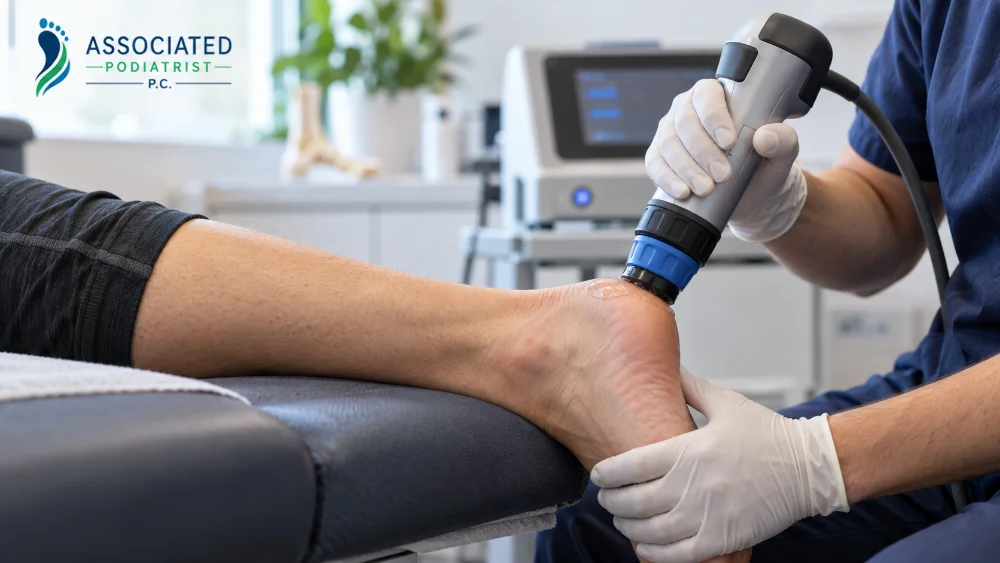
If chronic heel, arch, or Achilles pain is holding you back and basic care has not helped, shockwave therapy may be worth asking about. Associated Podiatrists, P.C. is a foot and ankle practice in Novi, Michigan that serves patients from Walled Lake and surrounding communities. The practice does not have a Walled Lake office, so shockwave therapy, also called extracorporeal shock wave therapy or ESWT, is provided at the Novi office at 26750 Providence Pkwy. Walled Lake patients can arrange an evaluation with Marc A. Borovoy, DPM, or John D. Miller, DPM, to determine the cause of persistent foot or ankle symptoms and whether shockwave therapy may be appropriate.
When Persistent Heel or Tendon Pain Leads Walled Lake Patients to Ask About Shockwave Therapy
Persistent heel, arch, or Achilles tendon pain can interfere with walking, exercise, work, and other daily movement, especially when basic measures have not provided enough improvement. For patients from Walled Lake, an important first step is determining what is causing the symptoms rather than assuming that shockwave therapy is automatically the right treatment.
Associated Podiatrists evaluates Walled Lake patients at its Novi office. A podiatrist can review the symptoms, treatment history, and clinical findings to determine whether extracorporeal shock wave therapy, continued conservative care, or another foot and ankle treatment may be appropriate.
What Shockwave Therapy Is and How ESWT Fits Into Foot and Ankle Care
Extracorporeal shock wave therapy, or ESWT, is a noninvasive treatment that applies mechanical or acoustic pressure waves to a targeted treatment area from outside the body. At Associated Podiatrists, ESWT may be considered for selected chronic foot and ankle soft-tissue conditions after a podiatrist confirms the diagnosis and reviews the patient’s prior treatment.
Shockwave therapy is one treatment option rather than a guaranteed solution for heel or tendon pain. It does not guarantee pain relief, tissue healing, permanent results, or avoidance of surgery. Patients who want more treatment-specific detail can review Associated Podiatrists’ Extracorporeal Shock Wave Therapy service information.
Foot and Ankle Conditions That May Be Evaluated for Shockwave Therapy Near Walled Lake
Shockwave therapy may be considered for selected chronic soft-tissue conditions of the foot and ankle after a podiatrist confirms the diagnosis. Conditions such as persistent plantar fascia pain, heel pain, and Achilles tendon pain may be evaluated for ESWT when symptoms have not improved enough with conservative care.
Chronic Plantar Fasciitis and Persistent Heel Pain
Chronic plantar fasciitis & persistent heel pain are among the foot conditions the podiatrists may evaluate when considering shockwave therapy. If symptoms have continued despite treatments such as stretching, orthotics, medication, or other conservative care, an evaluation can help determine whether ESWT or another treatment is appropriate. Patients can also review the practice’s plantar fasciitis and extracorporeal shock wave therapy resources for more information about these conditions and treatment options.
Achilles Tendon Pain and Chronic Tendonitis
Chronic Achilles tendonitis that has not improved with conservative care is another condition for which shockwave therapy is sometimes considered. Because the Achilles tendon is heavily used by walkers and runners, persistent pain there is worth having evaluated rather than pushing through.
Related Foot and Ankle Care Available at the Novi Office
Shockwave therapy is one treatment option within Associated Podiatrists’ broader foot and ankle care. If ESWT is not appropriate for a patient’s condition, the podiatrist can discuss other options based on the diagnosis, which may include custom orthotics, medication or injections, bracing, physical therapy or exercise guidance, MLS laser therapy, or surgical evaluation when clinically necessary. Treatment recommendations are individualized according to the cause of the patient’s symptoms and clinical findings.
When ESWT May Be Considered After Conservative Foot or Ankle Care
Shockwave therapy is not appropriate for every patient or every cause of foot pain. For selected chronic heel or tendon conditions that have not improved enough with conservative care, a podiatrist may discuss ESWT as one treatment option after confirming the diagnosis and reviewing the patient’s overall treatment history.
A Noninvasive Option to Discuss Before Surgery
For some chronic conditions that have not responded to conservative care, ESWT gives patients a noninvasive option to consider before moving toward surgery. It does not guarantee that surgery can be avoided, but it can be a reasonable step to discuss with your podiatrist as part of a broader plan.
How Prior Conservative Care Factors Into ESWT Candidacy
Shockwave therapy may be considered when heel or tendon pain has persisted despite measures such as rest, stretching, orthotics, medication, or other conservative care. For Walled Lake patients with ongoing symptoms, an evaluation can help determine whether ESWT may be an appropriate next step or whether another treatment approach better fits the diagnosis.
Candidacy Depends on the Diagnosis & Treatment History
Not everyone is a candidate for shockwave therapy. The podiatrists review your history, examine the area, confirm the diagnosis, and check for reasons the treatment would not be suitable before recommending it. Candidate selection, the treatment course, and expected results are always determined by that clinical evaluation.
How a Shockwave Therapy Evaluation Works at the Novi Office
A Walled Lake patient’s first step is an evaluation at Associated Podiatrists’ Novi office. The podiatrist reviews the symptoms, how long they have been present, previous treatment, relevant medical history, and the activities that affect the problem. The foot or ankle is then examined, and imaging or other diagnostic testing may be considered when clinically appropriate to clarify the diagnosis.
If ESWT is appropriate, the podiatry team can explain the treatment area, proposed treatment course, expected sensations, activity guidance, follow-up, and other options that may still be relevant. If shockwave therapy is not a good fit, the evaluation can instead guide the patient toward another treatment based on the diagnosis.
What to Expect During and After a Shockwave Therapy Session
Treatment sensation can vary depending on the area being treated, the patient’s sensitivity, and the treatment approach. Before ESWT begins, the podiatry team can explain what to expect during the session, and patients should tell the provider if they experience significant discomfort.
Temporary effects reported with extracorporeal shock wave therapy can include pain or tenderness during or after treatment, skin redness, bruising, or swelling. Activity recommendations and follow-up depend on the condition being treated and the individual treatment plan. Patients should follow the instructions provided for their specific foot or ankle condition rather than assume that the same recovery guidance applies to everyone.
Meet the Novi Podiatrists Evaluating Walled Lake Patients for Shockwave Therapy
Whether shockwave therapy is appropriate depends on an accurate diagnosis and clinical evaluation. Associated Podiatrists’ Novi team includes Marc A. Borovoy, DPM, who is board certified in foot and ankle surgery by the American Board of Foot and Ankle Surgery, and John D. Miller, DPM, who is board certified in foot surgery and reconstructive rearfoot and ankle surgery by the American Board of Foot and Ankle Surgery. Their podiatric and surgical backgrounds support comprehensive evaluation of foot and ankle conditions, while the decision to use ESWT is made case by case.
Dr. Marc A. Borovoy, DPM
Dr. Borovoy has provided podiatric care for more than thirty years and is board certified in foot and ankle surgery by the American Board of Foot and Ankle Surgery. He earned his Doctor of Podiatric Medicine degree from the Ohio College of Podiatric Medicine in Cleveland and completed postgraduate surgical training at Straith Memorial Hospital in Southfield, Michigan. He served for fourteen years as chief of the podiatry section at Providence Hospital in Southfield and is a past president of the Michigan Podiatric Medical Association. He treats patients of all ages for conditions including plantar fasciitis, tendonitis, diabetic ulcers, and neuropathy, and he chairs the board of the Bone and Joint Surgery Center of Novi.
Dr. John D. Miller, DPM
Dr. Miller is a Michigan native who earned his undergraduate degree from the University of Michigan and his Doctor of Podiatric Medicine degree from the Ohio College of Podiatric Medicine in Cleveland. He completed surgical training in foot and ankle reconstruction at Highlands and Presbyterian St. Luke’s Medical Center in Denver and joined Associated Podiatrists in 2002. He is board certified in foot surgery and in reconstructive rearfoot and ankle surgery by the American Board of Foot and Ankle Surgery, and he is a Fellow of the American Society of Podiatric Surgeons. His work spans reconstructive surgery, sports injuries, diabetic wound care, and pediatric foot and ankle care.
Reviews From Patients of Associated Podiatrists
These reviews reflect individual patient experiences with Associated Podiatrists, P.C. They are not specific to shockwave therapy and do not guarantee the same experience, diagnosis, treatment, or medical outcome for every patient. Care needs and experiences vary by individual.
“Dr. Borovoy is very knowledgeable and listens to his patients. I highly recommend him.”
- Regina Rogers
“My family has been going to Associated Podiatrists for 9 years. Everything about our experience has been extremely positive, we have been there for everything from a sprained ankle to surgery. We can always get in for an appointment, the office staff are very welcoming and helpful, and the nurses/medical assistants are caring. We have seen Dr Miller mostly, and he is very thorough, takes all the time you need to explain his findings, and presents all the treatment options. Honestly, I wish we had the same experience for all our health care needs.”
- Michelle Lopus
“Dr. Miller is a great doctor. I was terrified before the operation and after. I felt I would have to battle for understanding. Dr Miller was instinctive, actively listening to my concerns and responsive. I was a cry baby too, I could not understand my complication. Dr Miller determined I was hyper sensitive and helped me. Thank God for a doctor who cares enough to hear his patient!!”
- Kandra Chinnshaw
Where Walled Lake Patients Receive Shockwave Therapy: Novi Office Details
Associated Podiatrists does not have an office in Walled Lake. Shockwave therapy is provided at the Novi office at 26750 Providence Pkwy #130, Novi, MI 48374. Patients from Walled Lake travel to Novi for evaluation and treatment when ESWT is appropriate for their condition.
Beck Road is a north-south corridor through the Walled Lake/Wixom and Novi area. Patients should use current navigation or contact the office for directions before visiting, since traffic and road conditions can change.
Communities Served Through the Novi Office Near Walled Lake
Associated Podiatrists serves patients from Walled Lake through its Novi office and also sees patients from nearby communities including Wixom, Wolverine Lake, and Commerce Township. The physical office is in Novi at 26750 Providence Pkwy #130.
Associated Podiatrists serves patients from Walled Lake through its Novi office & also sees patients from nearby communities including Wixom, Wolverine Lake, & Commerce Township. The physical office is in Novi at 26750 Providence Pkwy #130.
Walled Lake Landmarks & the Route to the Novi Office
Within Walled Lake, the Michigan Air Line Trail and Mercer Beach near Downtown Walled Lake are familiar community locations. Beck Road is a major north-south roadway through the Walled Lake/Wixom and Novi area. Associated Podiatrists provides shockwave therapy at its Novi office at 26750 Providence Pkwy #130, and patients should use current navigation or contact the office for directions before visiting.
Novi Office Information for Walled Lake Shockwave Therapy Patients
For questions about a shockwave therapy evaluation, what to bring, or office logistics, contact the Associated Podiatrists team in Novi. The office can explain how an initial evaluation works and help you plan a visit from Walled Lake. If you have imaging or records from prior foot or ankle care, ask the office whether those records should be brought or sent before your appointment.
- Address: 26750 Providence Pkwy #130, Novi, MI 48374
- Website: https://associatedpodiatristspc.com/
- Hours:
Monday 8:30 AM to 4:30 PM,
Tuesday and Thursday 8:15 AM to 4:30 PM,
Wednesday 8:30 AM to 4:30 PM,
Friday 8:30 AM to 4:00 PM.
Closed Saturday and Sunday.
Associated Podiatrists, P.C. 26750 Providence Pkwy #130, Novi, MI 48374
Shockwave Therapy in Walled Lake, MI: Frequently Asked Questions
Shockwave therapy, or ESWT, applies mechanical or acoustic pressure waves to the treatment area and may be considered for selected chronic foot and ankle conditions such as plantar fasciitis and persistent heel pain. At Associated Podiatrists, ESWT is considered only after a podiatrist confirms the diagnosis and determines whether the treatment fits the patient’s condition. Treatment does not guarantee pain relief, tissue healing, or a specific outcome.
There is no single number of shockwave therapy sessions that applies to every patient. The treatment course depends on the diagnosis, symptoms, health history, and clinical response. If ESWT is recommended, the podiatrist will explain the proposed treatment schedule and follow-up plan for your specific condition.
There is no single improvement timeline that applies to every patient. Response to shockwave therapy can vary based on the condition being treated and individual factors. Your podiatrist can discuss realistic expectations during the evaluation and reassess your response as treatment progresses.
Treatment sensation can vary according to the area being treated, the patient’s sensitivity, and the treatment approach. Before ESWT begins, the podiatry team can explain what to expect during a session. Patients should tell the provider if they experience significant discomfort during treatment so it can be addressed appropriately.
Candidacy depends on the diagnosis, the condition being treated, previous care, relevant health factors, and whether there are reasons ESWT would not be appropriate. Shockwave therapy may be considered for selected chronic conditions such as plantar fasciitis, persistent heel pain, or Achilles tendonitis when conservative treatment has not provided enough improvement. A podiatric evaluation is required to determine whether it fits your case.
Chronic Achilles tendonitis is one of the conditions for which shockwave therapy is sometimes considered when rest, stretching, and other measures have not helped. Whether it is appropriate depends on your specific diagnosis. A podiatrist can evaluate the tendon and explain your options.
Recovery and activity guidance depend on the condition being treated and the individual treatment plan. Your podiatrist will explain whether any activity changes are appropriate after a shockwave therapy session and when to resume higher-impact activities. Follow the instructions provided for your specific foot or ankle condition.
Temporary effects reported with ESWT can include pain or tenderness during or after treatment, skin redness, bruising, or swelling. The likelihood and significance of side effects depend on the treatment area, health history, and individual clinical factors. A podiatrist should review the possible benefits, risks, and reasons ESWT may not be appropriate before treatment.
Steroid injections and shockwave therapy are different treatment approaches for selected foot and ankle conditions. Injections may be used as part of treatment for pain and inflammation, while ESWT uses mechanical or acoustic energy applied to the affected area. Which option is appropriate depends on the diagnosis, prior treatments, health factors, and clinical evaluation.
For some patients, ESWT offers a noninvasive option to try before considering surgery, but it does not guarantee that surgery can be avoided. Outcomes depend on the condition and the individual. Your podiatrist can discuss where shockwave therapy fits within your overall treatment plan.
Yes. Shockwave therapy may be considered when plantar fasciitis has persisted despite stretching, orthotics, and other conservative measures. Patients from Walled Lake can receive an evaluation at the Novi office to confirm the diagnosis and determine whether ESWT or another treatment may be an appropriate next step for their heel pain.
It can be, depending on the diagnosis. Active adults and runners from Walled Lake with lasting Achilles pain are among those a podiatrist may evaluate for ESWT once other measures have fallen short. An in-person assessment of the tendon is needed to confirm whether it is appropriate.
Persistent or recurring heel pain may be evaluated for shockwave therapy, but the length of time symptoms have been present does not by itself determine whether ESWT is appropriate. A podiatrist should first identify the cause of the heel pain and determine whether shockwave therapy or another treatment better fits the condition.
It is reasonable to ask about shockwave therapy when persistent foot or heel pain has not improved enough with conservative measures such as rest, supportive footwear, stretching, orthotics, or medication. A podiatrist can evaluate the cause of the symptoms and determine whether ESWT belongs in the treatment plan.
Shockwave therapy may be evaluated for chronic plantar fasciitis, persistent heel pain, Achilles tendonitis, and certain other long-standing tendon or soft-tissue conditions of the foot and ankle. A podiatrist confirms the diagnosis and considers the patient’s health history and previous treatment before recommending ESWT. Patients from Walled Lake receive this evaluation at the Novi office.
Shockwave Therapy and Heel Pain Resources
For more information about extracorporeal shock wave therapy, plantar fasciitis, heel pain, and treatment considerations, use the Associated Podiatrists and independent patient resources below.
From Associated Podiatrists
Considering Shockwave Therapy Near Walled Lake?
If chronic heel, arch, or Achilles tendon pain has continued despite conservative care, Associated Podiatrists can evaluate the cause and determine whether shockwave therapy or another treatment may be appropriate. Patients from Walled Lake receive evaluation and treatment at the Novi office at 26750 Providence Pkwy.
Talk With the Novi Podiatry Team About Your Treatment Options
- Address: 26750 Providence Pkwy #130, Novi, MI 48374
- Website: https://associatedpodiatristspc.com/
- Hours:
Monday 8:30 AM to 4:30 PM,
Tuesday and Thursday 8:15 AM to 4:30 PM,
Wednesday 8:30 AM to 4:30 PM,
Friday 8:30 AM to 4:00 PM.
Closed Saturday and Sunday.
Associated Podiatrists, P.C. 26750 Providence Pkwy #130, Novi, MI 48374